
Best Online Casino Game Shows in the UK: How They Work
 Available in GB
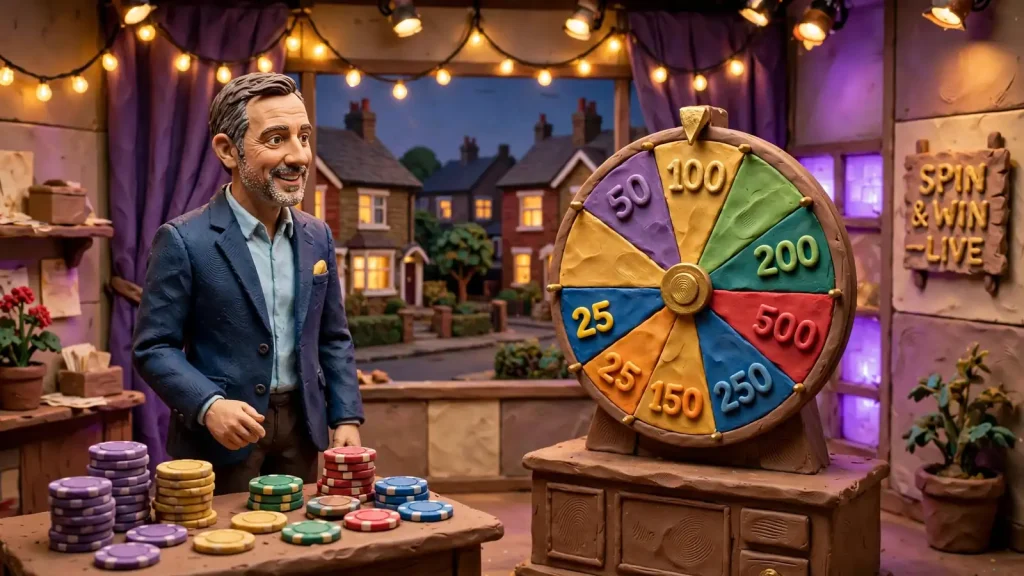
Live casino game shows pair a presenter-led TV format with defined game rules, wagers and outcome-generating systems.
How Online Casino Game Shows Work as a Format
Live casino game shows combine a gambling game with the presentation style of a television programme. Instead of showing only cards, reels or a roulette wheel, the screen normally includes a presenter, a studio set, animated graphics, music and a sequence of clearly defined stages. You place a wager through the casino interface, the show moves through its next game event, and the result is settled by the platform.
The important distinction is between presentation and outcome. The presenter may explain the rules, announce selections and maintain the pace, but the visual performance does not itself determine whether your wager wins. The result comes from the game’s rules and its outcome-generating system. A polished set can make the format easier to follow, but it cannot turn an unfavourable paytable into a favourable one.
That is why assessing the best online casino game shows in the UK requires more than asking whether a title looks entertaining. You need to separate four parts of the experience:
- the underlying game rules;
- the way a round is operated and timed;
- the bets and payouts available to you;
- the quality of the interface and presentation.
If one of those parts is unclear, the show may be enjoyable to watch while still being difficult to assess as a gambling product.
The basic cycle of a live game show
Most online casino game shows follow a repeating cycle. The interface opens betting for a round, displays the available selections, and shows the value or potential return attached to each one. You choose a stake and confirm it before betting closes. The host or game system then carries out the event: a wheel is spun, a numbered outcome is selected, a panel is opened, or another defined action takes place. The result is displayed, winning wagers are settled and the next betting period begins.
The exact sequence varies, but the logic is consistent:
- Betting opens. The game shows the options that can be selected.
- You choose a wager. This may involve a direct outcome, a bonus feature or both.
- Betting closes. Further entries for that round are no longer accepted.
- The game event occurs. The host may operate it physically, or the studio presentation may accompany an automated outcome.
- The result is settled. The balance reflects any return according to the published rules.
- A new round starts.
This cycle is different from a conventional slot session, where you normally initiate each spin yourself and the interface presents the outcome immediately. In a live show, the pace is shared by all viewers connected to the same game feed. You are joining a scheduled sequence rather than running an isolated event whenever you press a button.
That shared timing explains several interface features. A countdown indicates how long remains before betting closes. A status label may show whether the game is accepting bets, processing the result or preparing the next round. If you join after betting has closed, you normally have to wait rather than force the current round to accept your wager.
What “live” means in practice
The word “live” describes the presentation and operation of the game, but it should not be treated as a guarantee of a particular physical process. Some shows use a presenter and studio equipment in real time. Others combine live hosting with automated or digitally controlled parts of the round. The relevant question is not whether the set resembles a television studio. It is how the product explains the source of the result and the way that result is connected to your bet.
A live dealer format typically places a human presenter at the centre of the action. The presenter may spin a wheel, reveal a result or manage a table. A game-show format usually adds more production elements: themed stages, sound effects, animated bonuses, audience-style responses or a more elaborate progression from the base round to a feature. These labels describe the experience, not a single universal rule set.
You should therefore inspect the information attached to the individual title. Look for an explanation of:
- what event produces the result;
- which selections can be wagered on;
- when betting closes;
- how ties, cancellations or interruptions are handled;
- how a bonus stage is entered;
- how returns are calculated.
A presenter can make an unfamiliar game understandable, but the presenter’s explanation is not a substitute for the written rules. If the spoken description and the written terms appear to differ, the written game information is the part that needs careful examination before you stake money.
The role of the presenter
The presenter serves several practical functions. They identify the current stage of the round, announce when betting is open or closed, explain the result and maintain continuity while the next round is prepared. This is especially useful when the game includes a feature sequence that is harder to understand from static graphics alone.
The presenter can also influence the perceived speed of the game. Pauses, announcements and visual transitions make the round feel like a programme rather than a bare random event. That atmosphere is part of the product’s design. It does not alter the mathematical relationship between your stake, the possible outcomes and the published returns.
Don’t follow patterns
Attention A host’s excitement or a repeated outcome does not make a particular selection more likely in the next round. Previous outcomes do not provide a reliable prediction of the next one.
You should not treat commentary as a signal. A host’s excitement, a repeated outcome or a dramatic pause does not make a particular selection more likely in the next round. The same applies to language suggesting that a feature is “due” or that a result has created a pattern. Unless the rules explicitly create a dependency between rounds, previous outcomes do not provide a reliable prediction of the next one.
Base rounds and feature rounds
Many casino game shows have a base game and one or more feature stages. The base game is the part that occurs in every ordinary round. It may offer a set of direct betting options, with each option linked to a different return if it wins. A feature round is an additional event that can be triggered by a particular result or selection.
A feature might ask you to choose from visible options, reveal symbols in sequence or follow a separate prize structure. Sometimes your original wager determines whether you participate. Sometimes a feature is automatically awarded by the round result. These are different mechanisms and should not be confused.
The key assessment is whether the feature changes your actual wager or merely changes the possible return. Read the rules for:
- the event that triggers entry;
- whether the trigger depends on your selected bet;
- whether a separate wager is required;
- whether the feature has its own outcomes and payments;
- whether the displayed prize is a fixed return, a multiplier or another form of settlement.
A large visual prize can attract attention while representing only one branch of the feature tree. The relevant figure is the return attached to the outcome you can actually reach under the rules, not the most prominent number shown during the presentation.
Understanding the betting panel
The betting panel is the operational core of an online casino live game show. It translates your choices into a wager that the system can settle. Before joining a round, identify what each selectable area means and whether it represents a separate bet.
Common distinctions include:
- a selection tied to the main outcome;
- a selection that enters or improves a bonus feature;
- a side bet with its own result;
- an option that covers several outcomes but pays differently from a single selection.
Do not assume that visually adjacent options are equivalent. Two buttons may appear in the same row while carrying different settlement rules. Likewise, a selection with a higher advertised return may have a narrower winning condition.
The panel should show the stake before confirmation and make it clear which choices are active. After you confirm, check that the wager appears in the round summary. If the interface does not make the accepted bet visible, you cannot easily tell whether a click changed the stake, selected an option or did nothing because betting had already closed.
The balance display also needs interpretation. A deduction may appear when the wager is accepted, while a return may be added only after the result is settled. That timing is a display process, not an additional outcome. The rules determine whether a winning return includes the original stake or represents profit in addition to it, so this point should be stated in the paytable or help panel.
Payouts, probability and house advantage
A payout table tells you what the game returns for a winning selection. It does not, by itself, tell you how often that selection wins. To assess the bet properly, you need both the return and the chance of the relevant outcome under the game’s rules.
Calculation Principle
Example: 10 × 0.5 = 5. (Note: Probability × Return = Expected Return)
This is the basic relationship:
expected return = probability of an outcome × return for that outcome, considered across all possible outcomes and bets.
You do not need to calculate this for every title to understand the principle. A high advertised multiplier normally corresponds to a less frequent or more restricted result. A selection that wins more often may pay less when it does. The apparent excitement of a feature does not remove this trade-off.
Look for the game’s stated return information where it is provided, but do not confuse a published theoretical figure with a promise for your session. A theoretical return describes the long-run behaviour of the game under its rules. Individual rounds can produce a very different sequence, and a short session cannot be used to prove that a game is favourable or unfavourable.
It is also useful to distinguish a multiplier from a cash return. A multiplier may be applied to the stake connected to a particular bet. A displayed prize may instead be linked to a feature outcome with separate conditions. Read the wording rather than assuming that every number on screen is added directly to your balance.
Round speed and decision time
The pace of a show affects how easily you can inspect a wager before committing to it. A fast round may feel efficient, but it leaves less time to reread the rules, compare selections or notice that a betting window is about to close. A slower show may provide more time for decisions while also creating longer gaps between results.
Best Online Casinos With No Limits: UK Rules · Wazdan Online Casinos in the UK: What to Check · Amatic Games at UK Online Casinos: How Access Works
This is not merely a question of entertainment. Speed affects how many decisions you are invited to make and how quickly your balance can change. If the interface encourages automatic participation in every round, disable or avoid that behaviour unless the rules and your intended spending are already clear. A live show should not be treated as a continuous command to stake whenever betting opens.
Watch the transition between rounds before making a substantial decision. Confirm how long the betting phase remains open, whether a confirmed bet can be changed, and what happens when the connection drops at the closing point. These details determine whether a late click is accepted, rejected or recorded differently from what you expected.
Streaming, software and displayed results
A live game show uses two connected layers. The first is the stream or visual presentation: video, audio, graphics and the presenter’s actions. The second is the betting system that records your selection and settles it. A problem with the stream does not automatically mean that the betting system failed, and a stable video feed does not prove that a wager was accepted.
For that reason, the interface should provide a separate record of your active bets and settled results. If the picture freezes, check the account or round information rather than attempting to place another wager immediately. Refreshing the page can also change what is visible without changing what has already been recorded.
Interface Reliability
The betting system is separate from the visual stream; a frozen video feed does not mean a placed wager was not recorded.
Mobile access adds another layer of practical risk. A smaller screen can hide help links, betting history or part of the paytable. A weak connection can delay the stream while the game continues. Before relying on a mobile browser, make sure you can see the selected bet, the round status and the settlement history without guessing from an animation.
How to assess a show before playing
A disciplined assessment starts with the rules, not the studio design. Use the following sequence:
- Read the round description. Establish what event produces the result.
- Map every bet. Identify the winning condition and return for each selectable option.
- Separate the base game from features. Find out what triggers an additional stage and whether it requires a separate bet.
- Check the timing. Observe when betting opens and closes and whether accepted bets can be amended.
- Review the settlement wording. Confirm how stakes, returns, cancellations and interrupted rounds are handled.
- Test the interface with the lowest permitted stake you intend to use. Verify that the bet appears correctly and that the result is recorded in the account history.
- Assess the pace. Decide whether you can make deliberate choices without relying on the presenter or countdown.
This process applies whether the programme is a wheel-based show, a reveal-based game or another live casino game-show format. The visual theme may change, but the assessment problem remains the same: identify the event, the wager, the timing and the settlement.
Entertainment is not evidence of value
Casino game shows are designed to hold attention through sound, motion, anticipation and social presentation. Those elements can make the format more engaging than a static game interface. They can also make the passage of time and money less noticeable.
Treat the show’s production quality as a feature of the experience, not as evidence that the bets are better. A charismatic host does not improve the odds, a crowded chat does not validate a strategy, and a sequence of recent results does not establish what will happen next. The product should be judged by its rules, transparent betting options, settlement process and suitability for the way you intend to play.
Once those mechanisms are clear, you can decide whether the live presentation adds value for you or merely adds stimulation. The best online casino game shows are not defined by the loudest graphics or largest on-screen prize. They are the formats whose rules you can explain, whose bets you can identify before confirming them, and whose results you can verify afterwards.
Recommended online casinos
- JetsetspinsBonus: 200% Bonus + 100 Free Spins + Free Royal Wheel · Payout speed: 1-3 business days
- WinBeastBonus: €5000 + 500 FS + €650 Freebet · Payout speed: 1-3 business days
- BritsinoBonus: Welcome Package – Get your £2,200 + 2,000 FS · Payout speed: 1-3 business days
- BeOnBetBonus: 100% up to €500 + 100 FS · Payout speed: 1-3 business days
- ChanzeBonus: Slots Welcome Bonus #1 200% up to €500 · Payout speed: 1-3 business days
- SpinFormulaBonus: 550% Up To £15,000 + 550 FS · Payout speed: 1-3 business days
- x3betBonus: Welcome Pack 100% Up to £1.000 + 200 Free Spins · Payout speed: 1-3 business days
- AmunbetBonus: Join now and get 450% up to 2,700 GBP + 450 FS · Payout speed: 1-3 business days
- SlotoSportBonus: 500% up to £ 10 200+ 777 FS · Payout speed: 1-3 business days
UK Licensing: What It Does and Does Not Tell You
When you look for online casinos with live game shows in the UK, two separate questions are easy to merge:
- Is the business legally authorised to provide remote gambling to customers in Great Britain?
- Does that casino currently display the particular live game show you want to play?
A positive answer to the first question does not automatically produce a positive answer to the second. A UKGC licence concerns the operator’s authority to conduct gambling activity. It is not a catalogue of every game available in the operator’s lobby, and it does not mean that every live game-show format is permanently offered there.
Which regulator covers commercial gambling?
The UK Gambling Commission is the regulator responsible for commercial gambling in Great Britain. Its remit includes online casinos and other forms of remote gambling made available to consumers in Great Britain. In practical terms, the relevant authority is determined by the gambling service being supplied to the customer, not simply by where a company’s servers, offices or other technical equipment happen to be located.
That point matters for an online casino. A business may be incorporated outside Great Britain or use technical infrastructure in another country, but that location does not remove the requirement for the relevant UKGC licence when the business offers remote gambling to consumers in Great Britain. The location of the key equipment is not the deciding test.
The Gambling Commission also has a wider role than checking casino websites. It regulates commercial gambling activity and issues licences to businesses. It also grants personal licences to individuals who perform regulated operating functions. These are different permissions with different subjects:
- an operating licence belongs to the business conducting the gambling activity;
- a personal licence belongs to an individual working in a relevant operating role.
For a customer choosing among live game-show casinos, the operating licence is the main business-level concept. A personal licence is not a substitute for the operator’s authorisation, nor is it a badge that identifies whether a particular game is in the lobby.
What an operator licence means
A remote casino serving Great Britain must hold the appropriate UKGC operating licence. This is the legal basis for the operator’s remote gambling activity. Without that authorisation, the casino is not a legal online casino for the British market.
The licence attaches to the operator and its regulated activity. It does not attach to every game title as though each title had received an individual approval displayed beside it. Therefore, seeing a game-show tile, a live table or a provider name on a casino website is not the same as verifying the operator’s legal status.
The relationship can be represented simply:
| Question | What it concerns |
|---|---|
| Is the casino allowed to offer remote gambling to Great Britain? | The operator’s UKGC operating licence |
| Is a particular live game show visible today? | The casino’s current product catalogue |
| Is a named provider involved? | The supply and distribution of the game |
| Can a particular customer use the service? | The operator’s account and customer controls |
These questions interact, but they are not interchangeable. A licensed operator may change its catalogue. A title may be added, removed, or made unavailable in a particular interface without the operator’s legal status changing. Conversely, a casino’s attractive lobby does not establish that the business holds the required operating licence.
A licence is not a game-list guarantee
The phrase “licensed casino with live game shows” describes two attributes, not one. “Licensed” refers to the operator’s legal authorisation. “With live game shows” refers to the content made available through that operator at the time you view it.
This distinction prevents a common reasoning error. Suppose an online casino is known to hold a UKGC licence. That fact supports the conclusion that the business is authorised to provide remote gambling in Great Britain. It does not support the further conclusion that the casino offers every live game show, every provider’s catalogue, or even a particular title you saw elsewhere.
DO
- Check the operator’s UKGC operating licence
- Verify the game availability in the specific casino lobby
DON’T
- Assume a game title is available just because it is advertised
- Mistake a supplier’s software licence for an operator’s licence
The reverse error is also possible. A website may advertise a live game show prominently, but the presence of that feature does not by itself prove that the operator is authorised for the British market. The game’s appearance is evidence about the website’s product presentation, not a replacement for checking the business’s licensing position.
This is why a page discussing the best live game-show casinos should not treat a lobby screenshot, a search result, or a provider logo as regulatory proof. Product evidence and licensing evidence answer different questions.
The operator and the game provider have different roles
A casino operator is the business that presents the gambling service to you. It manages the customer account and provides the interface through which you access the games. The game supplier is a separate part of the commercial chain where an external provider supplies software or content to operators.
That separation matters when a named game appears in a casino lobby. The provider’s participation does not transfer the operator’s responsibilities to the provider. The operator remains the business whose licence matters for the remote gambling service offered to the customer.
Amatic Industries illustrates the distinction on the software side. It holds a UK Gambling Software (Remote) licence, which permits it to supply games to British operators. It is not a consumer-facing casino: it does not take deposits from British players, settle their winnings, or provide their casino account support. Those customer-facing functions belong to the operator through which the game is offered.
The two licences therefore answer different questions:
- the operator’s UKGC operating licence concerns the business offering remote gambling to the customer;
- the supplier’s UK Gambling Software (Remote) licence concerns the supply of gambling software to authorised operators.
A supplier licence should not be read as permission for the supplier to accept players directly. Equally, an operator’s licence should not be read as proof that every software supplier or every title is present in its lobby.
Why a provider name is not a register entry
A provider may be named on a casino page, in a game filter or in an editorial description. That is a commercial and product-related reference. It is not the same as an entry showing that the casino itself holds a UKGC operating licence.
The Gambling Commission’s licensing function concerns businesses and individuals within the regulated system. A game catalogue is not a parallel register of approved casinos. When a casino lists a provider, the listing indicates a supply relationship or a product placement; it does not replace checking the operator’s authorisation.
This distinction is especially important with live game shows because their presentation can make the provider, studio or host appear more prominent than the operator. The visual identity of the show may dominate the page, while the customer account, deposits, payouts and complaints route remain connected to the casino operator. Regulatory responsibility should therefore be traced to the business offering the gambling service, not to the most visible brand on the game screen.
Licence vs Catalogue
A UKGC licence authorises the business to operate but does not guarantee the presence of every specific game in its lobby.
Remote gambling and physical location
Remote gambling is regulated by the service offered to the consumer in Great Britain. A casino cannot avoid the relevant licensing requirement merely by placing its key equipment elsewhere. This rule prevents a technical argument from being used to change the legal character of a customer-facing service.
For you, the practical implication is narrow but important: the country shown in a company’s address is not enough to determine whether the casino is authorised to serve Great Britain. A foreign location does not itself prove illegality, and it does not itself prove authorisation. The relevant question is whether the operator that offers the remote gambling service holds the necessary UKGC operating licence.
This also explains why an offshore casino must not be treated as equivalent to a UKGC-licensed operator simply because it carries familiar games or uses a professional-looking website. Offshore businesses operate outside the UKGC regulatory system and do not hold a UKGC licence. Their presence online does not place them inside the British licensing framework.
What licensing can establish
A current UKGC operating licence can establish that the named operator is authorised within the British regulatory system for the relevant remote gambling activity. It gives the legal status of the business, not a prediction about the quality, popularity or availability of a particular live game show.
Licensing can therefore help you identify the correct legal category of a casino:
- a UKGC-licensed operator is within the British regulatory framework;
- an operator without a UKGC licence is not a legal online casino for serving UK players;
- an offshore licence is not a UKGC licence;
- a software licence held by a supplier is not an operator licence held by the casino.
The licence also does not turn an editorial recommendation into an official ranking. “Best” is a comparison label used by a publisher or reviewer. It is not a category created by the Gambling Commission. A regulator establishes the licensing framework; it does not certify one casino as the best destination for live game shows.
What licensing cannot establish
A licence alone cannot tell you:
- whether the casino has a particular live game show in its current lobby;
- whether the title is available to every customer or through every device;
- whether the game will remain available after the casino changes suppliers or catalogue sections;
- whether the show has the style, pace or rules you prefer;
- whether the operator’s product presentation matches an advert or older review.
Those are catalogue and product questions. They require checking the operator’s current offering rather than inferring availability from its regulatory status.
The same caution applies when several casinos display the same game. Their shared access to a title does not make them one business, and it does not make the provider responsible for the customer relationship. Each operator remains a separate entity whose authorisation must be considered separately.
Reading a casino page accurately
A casino page may contain several layers of information at once:
- Business identity — which company is offering the remote gambling account.
- Regulatory identity — whether that company holds the relevant UKGC operating licence.
- Product identity — which game shows and other titles the page currently displays.
- Supplier identity — which external company produced or supplied the software.
Do not use one layer as a substitute for another. A supplier logo cannot verify the operator. A game title cannot verify the casino. An operator licence cannot confirm that a particular show is available. Keeping these identities separate gives you a more accurate view of online casinos with live game shows in Great Britain and avoids treating a product listing as regulatory evidence.
Comparing Distinctive Live Game-Show Formats
Branded live game shows can look similar in a casino lobby while producing very different playing experiences. A title such as Crazy Time or Funky Time should therefore be treated as a format label, not as a complete description of how the game works. The name may suggest a theme, but it does not tell you how rounds are selected, how prizes are calculated, or how much control you have over the outcome.
The useful comparison is between mechanisms. Before comparing titles, separate the show into its visible presentation and its underlying game structure. The presentation includes the host, studio, graphics, music and pace. The structure determines what actually happens to your stake.
Comparison Guide
- Identify the exact randomising device used
- Separate the base game from feature rounds
- Compare the betting logic and map
- Evaluate the speed and information flow
Start with the decision that creates the result
The first distinction is the type of random event used by the show. Some formats may centre on a wheel, while others may use cards, numbered choices, doors, symbols or another selection device. You should identify the exact event that determines the result rather than relying on the theme.
This matters because a dramatic studio action can be separate from the gambling outcome. A host may spin, reveal or announce something, but the important question is which event fixes the winning result. If a bonus feature follows that event, determine whether it creates a new result, multiplies an existing one, or simply displays the result in a different way.
A useful description should allow you to trace the sequence:
- You place a stake on an available outcome.
- The show performs its main random action.
- The winning outcome is identified.
- Any additional feature is triggered or not triggered.
- The applicable payout is settled.
If the information does not make that sequence clear, the format has not yet been explained sufficiently for a meaningful comparison.
Separate the base round from feature rounds
Game-show branding often concentrates attention on special rounds. That can make two titles appear alike even when their ordinary rounds differ. Compare the base round first: what can you select, how many outcomes are available, and what happens when your selection is not the winning one?
Then examine the feature round as a separate mechanism. A feature may be entered through a particular result in the base round, or it may be available through another condition. It may involve a new choice, a multiplier, a prize reveal or an extended presentation. Those are not interchangeable features, even if all of them are marketed as a bonus.
The key comparison is not whether a show has a feature round. Many branded formats do. The key is what the feature changes. Does it change the payout attached to the original result? Does it replace the original result with a new one? Does it give you a decision, or does the system make every decision automatically? These distinctions affect the relationship between the visual show and the actual wager.
Compare the betting map, not just the headline theme
Two shows can use different themes while offering similar betting logic. Conversely, two shows with similar studio presentation can require very different selections from you. Draw the betting map in plain language.
For each available wager, record:
- the outcome it represents;
- whether it belongs to the base round or a feature;
- whether it can win independently of other selections;
- whether a feature can alter its settlement;
- whether a losing base result ends the round immediately.
This approach prevents a common misunderstanding: assuming that a visually prominent feature is available from every wager. A feature may be linked only to a particular result, or its effect may depend on the outcome that triggered it. The title alone cannot establish that relationship.
Look at pace and information separately
The speed of a show is part of its format, but it is not evidence of its value. A fast sequence can create more decisions in a shorter period, while a slower presentation may give you more time to read the rules and confirm your selection. Neither characteristic determines whether the game suits you.
Compare how information is presented before each round. Can you see the available outcomes and their settlement terms? Are the rules displayed in a form you can read without relying on the host’s commentary? Is the result recorded clearly after the action? A polished broadcast can still leave the important mechanics unclear if the interface gives priority to animation over explanation.
Presentation vs Math
Host style and entertainment value are presentation differences, not mathematical ones.
The same principle applies to the host. Hosting style is a presentation difference, not a mathematical one. An energetic presenter and a restrained presenter may deliver the same type of random event. Treat entertainment, speed and atmosphere as separate criteria from the wager and its settlement.
Treat branded names as titles, not guarantees
The words Crazy Time and Funky Time may identify particular branded concepts, but the name itself does not prove that either title is available at a particular casino, uses a particular betting structure, or has unchanged rules wherever it appears. Availability and presentation can depend on the operator’s current lobby and the version supplied there.
Do not infer that a similarly named game is an official variant. Check the title shown in the game window, the rule panel and the paytable. A familiar word in a lobby search result is not enough to establish that two products share mechanics.
A sound comparison therefore describes what can be observed and verified: the randomising device, the betting options, the trigger for any feature, the settlement sequence and the clarity of the rules. It avoids turning a memorable title into a promise about prizes, frequency or player control. Once those structural differences are clear, you can decide which style of live game show matches the way you prefer to follow a round, without confusing spectacle with the mechanism that determines the result.
EGT Casinos UK: Checking for Amatic Slots · Amatic Online Casinos in the UK: Games and Offers · New online casino sites UK: how Amatic games fit
What to Check Before You Join a Live Game Show
Choosing a live casino game show is a practical decision, not just a matter of picking the most attractive title in the lobby. Before you join, check what you are actually entering, how the stake is set, which terms apply, and whether the session fits the limits you have chosen for yourself.
Confirm that the game is available
Game availability can vary between operators. A title may appear in a search result, a review, or a provider catalogue but not be present in the casino account you intend to use. Search the operator’s own lobby after logging in, and check that the game can be opened from your device before making a deposit.
The label also matters. Some casino lobbies place live-hosted games, automated game-show-style titles, table games, and slots close together. Read the game description rather than assuming that every colourful show format uses the same rules. If the presentation suggests a live host but the information panel describes an automated game, you are assessing a different product.
Before You Play
- Search the operator’s lobby for the game
- Open the rules or help panel
- Confirm the stake amount
- Check the mobile browser compatibility
Check whether the game is available in the mobile browser as well as on a desktop. A title that loads on one device may have a different layout or may not be offered on another. Resolve that before you commit funds.
Read the rules before staking
Open the rules or help panel and identify the basic sequence of a round. You should be able to determine what action starts a round, when your stake is accepted, how outcomes are selected, and when a win is credited. If the wording leaves an important step unclear, do not treat the visual presentation as a substitute for the rules.
Pay particular attention to:
- the minimum and maximum stake shown for the selected game;
- whether different bets within one round have different prices or outcomes;
- whether a bonus feature requires a separate selection;
- how cancelled, interrupted, or disconnected rounds are handled;
- whether an unfinished round is settled automatically when you reconnect.
The displayed rules should also explain the game’s winning conditions. A large prize graphic does not tell you how often that outcome can occur or which bet types are eligible for it. Avoid staking until you can connect the bet you are placing with the result that would produce a return.
Check the real cost of participation
Set the stake before joining a round, and do not rely on the default value selected by the interface. A prominent button can make repeated participation feel like one continuous activity, while each click may create a new wager. Confirm the amount shown immediately before submitting it.
Use the operator’s financial-limit controls before depositing. UKGC-licensed operators must prompt you to set a financial limit before your first deposit, and a reduction to that limit must take effect immediately. Treat this as a control mechanism, not as a formality. A deposit limit, loss limit, or session limit controls a different part of your behaviour, so read the label carefully before saving it.
The UK online slot stake cap does not automatically describe every casino game. Live game shows and slots can use different classifications and rules. Check the stake information for the particular game instead of applying a limit from another product.
Do not count a bonus as available cash until you have read its conditions. Look for the eligible games, expiry condition, maximum conversion or withdrawal rules, and any wagering requirement. For UK players, bonus-fund wagering requirements are capped at ten times the bonus funds under the Gambling Commission’s rules, but the operator’s terms still determine how that requirement operates. A promotion can also exclude the game you wanted to play.
Amatic Slots in UK Casinos: How Games Reach Lobbies · BGaming Casinos in the UK: What to Check · Barcrest Online Casinos in the UK: What to Check
Check how payments and withdrawals work
Use a payment method that is permitted for remote gambling in Great Britain. Credit-card-funded remote gambling payments are not allowed, including credit-card-funded top-ups through an electronic wallet. The payment account should also match the identity details registered with the operator, because verification can affect your ability to withdraw.
Read the withdrawal section before depositing. Check which verification documents may be requested, whether the balance must be settled before an account can close, and whether promotional funds are separated from withdrawable cash. These checks are easier before a win than after one.
Never treat the provider of a game as the party responsible for your account. The casino operator handles your deposit, winnings, bonus terms, and customer support. If a round is interrupted or a payment is delayed, use the operator’s stated support route and keep the relevant game, transaction, and account details.
Set a stopping rule
Decide in advance what ends the session. That might be a time limit, a loss limit, or simply stopping after the amount set aside for entertainment has been used. Do not increase the stake to recover a previous loss; that changes the decision from planned participation to chasing.
If gambling is no longer controlled, use the operator’s available tools rather than relying on willpower. GamStop has been mandatory for GB-licensed online operators since 31 March 2020. A self-exclusion choice should be made before joining a live game show, not after an unwanted session has already continued.
Finally, check your age and account status before depositing. Remote gambling in Great Britain is for customers aged 18 and over, and the operator must verify age before allowing funds to be deposited. If the account cannot pass verification, do not attempt to bypass the check with another person’s payment method or details.
Are Amatic casinos safe and regulated in the UK?
Amatic is a software supplier, not a casino operator, and holds a UK Gambling Software (Remote) licence. The casino you use is responsible for deposits, payouts, bonus terms and customer support, so check that operator’s UK licence.
What is Amatic Industries and when was it founded?
Amatic Industries GmbH is an Austrian business-to-business gaming software supplier founded in 1993. It launched its online gaming division, AMANET, around 2010.
Are Amatic games licensed and legal to play in the UK?
Yes. Amatic holds a UK Gambling Software (Remote) licence, and its games are distributed to UK players through UKGC-licensed operators; the operator must hold the relevant licence for the casino service.
What are the wagering requirements at Amatic casino bonuses in the UK?
For UKGC-licensed operators, wagering requirements on bonus funds are capped at 10× from 19 December 2025. The operator sets the specific bonus terms, so check them before accepting an offer.